
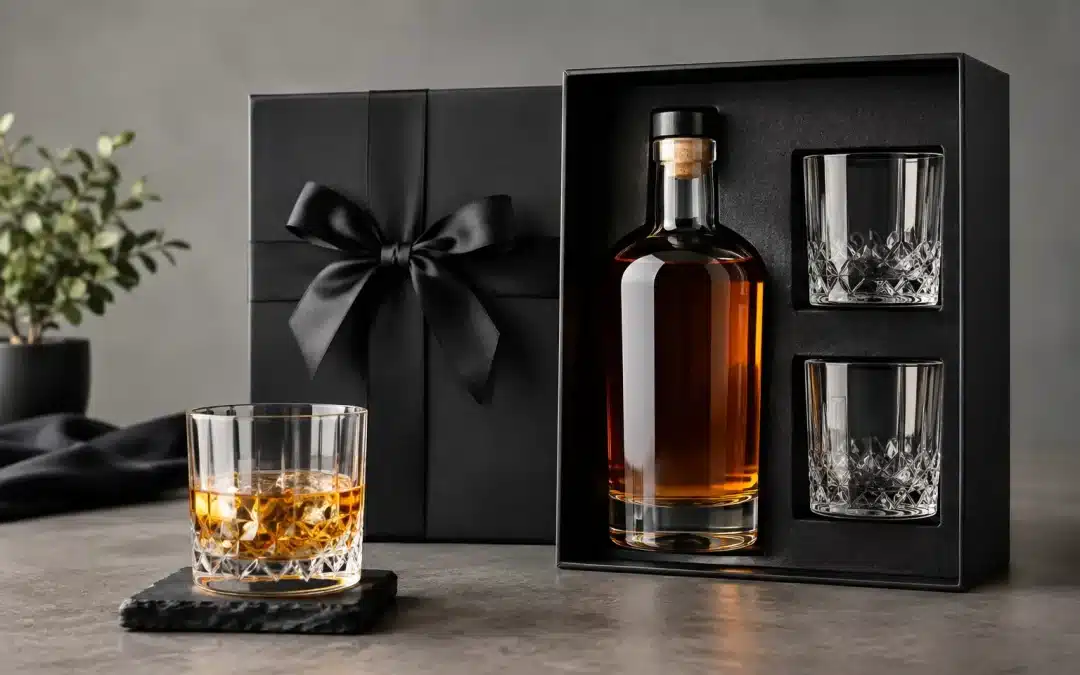
A bottle on its own can make a strong tasting-room purchase. Add the right glass and polished presentation, however, and it becomes a gift customers are more likely to choose, keep and talk about. This distillery promotion example shows how a spirits brand can turn a standard bottle-and-glass offer into a more valuable promotional set without making fulfilment unnecessarily complicated.
A distillery promotion example built to be kept
Imagine a local gin distillery preparing for the Christmas gift season. Its core offer is a 700 ml bottle of signature gin, but the team wants a promotion that feels more considered than a bottle in a branded bag. They pair every qualifying bottle purchase with two branded stemless gin glasses, presented in a fitted black card stock glassware box.
The promotion is not built around a deep discount. It is built around perceived value. Customers receive a ready-to-give set that looks appropriate for a client gift, a family celebration or a host present. The distillery benefits from a higher average transaction value, while the glasses continue to promote the brand long after the bottle has been enjoyed.
For the customer, the offer answers a practical question: “What can I give that looks good straight away?” For the distillery, it creates a reason to buy now rather than later.
Why the glassware matters
A well-chosen glass turns a bottle purchase into an occasion. Gin works naturally with balloon-style glasses or stemless tumblers, while whisky may suit a weighty rocks glass. Vodka and liqueur promotions can use shot glasses, and premium rum or whisky releases may be paired with a decanter or carafe for a more substantial gift.
The key is to match the item to how customers actually serve the product. A glass that feels useful at home has more promotional life than a novelty item that sits at the back of a cupboard. For a new release, a pair of glasses can also encourage sharing, which gives the customer another reason to open the bottle and remember the brand.
Branding on the glassware should support the promotion, not overpower it. A simple logo, distillery name or short campaign line often looks more premium than a crowded design. The packaging then protects the glassware and gives the complete set a retail-ready finish.
Presentation makes the offer easier to sell
A promotion can be commercially sound and still fall flat if it is awkward to display, carry or gift. Loose glasses wrapped at the counter may work for a small one-off order, but they can look inconsistent in a retail environment and create extra work for staff during busy periods.
A black cardboard glassware box provides an economical, professional option for distillery promotions. It suits brands seeking a classic, understated look and can be selected to suit single glasses, pairs of glasses, tumblers or selected decanter and carafe formats. The dark finish gives branded glassware a stronger contrast and helps the set look intentional before the customer even sees the bottle.
Clear PVC or PET glassware boxes offer a different advantage. They let customers see the glassware immediately, which can work well for counter displays, cellar doors, trade events and packaged gift sets where the shape or decoration of the glass is part of the appeal. Clear packaging can also reduce the need for staff to open a pack to explain what is included.
The best choice depends on the campaign. Black card stock generally suits a more premium, restrained gift look. Transparent packaging suits promotions where visibility and quick product recognition are the priority. Neither is automatically better – the intended display, transport requirements and price point should guide the decision.
Keep the bottle and glassware practical
Not every bottle-and-glass promotion needs one large, all-in-one pack. In many cases, it is simpler to package the glasses in a purpose-made box and sell or gift them alongside the bottle. This approach makes stock handling easier, gives the customer flexibility and avoids forcing a standard bottle shape into a packaging format that was not designed for it.
For example, the gin distillery could display the boxed pair of glasses beside the bottle, then place both in a larger carry bag at purchase. It still reads as one thoughtful gift, while each component remains easy to replenish, count and transport.
If the promotion is for corporate gifting or a larger retailer order, consistency matters even more. Glasses should arrive protected, packs should be simple for staff to identify, and the final presentation should be repeatable across every order. A package that looks excellent in a product photo but is slow to assemble may cost more in labour than it returns in sales.
Make the promotion work across more than one channel
The strongest distillery promotions do not rely on a single sales counter. The same glassware gift set can be adapted for cellar-door sales, online orders, corporate gifting and event activations, with minor changes to the message or quantity.
At the cellar door, the offer might be positioned as a limited seasonal gift set. Online, it can solve the problem of sending a present directly to someone else. For corporate buyers, the distillery could offer a larger pack of branded glasses with bottles supplied separately, suitable for staff gifts, client thank-yous or end-of-year functions.
Events create another useful application. A distillery hosting a launch night, tasting session or wedding expo can use boxed glassware as a door prize, VIP inclusion or sales incentive. Unlike a flyer, a quality glass has a practical purpose after the event. Packaged properly, it is also easier for guests to take home without worrying about breakage.
This is where reliable packaging becomes part of the promotion rather than an afterthought. It supports safe handling, improves the perceived value of the glassware and helps staff hand over a finished-looking product with confidence.
Set the numbers before setting the offer
A premium-looking promotion still needs to make commercial sense. Before committing to a glassware format or packaging quantity, calculate the fully landed cost of the promotion: glassware, decoration, packaging, assembly time, protective materials, freight and any expected breakage allowance.
Then decide what the promotion needs to achieve. If the objective is to move a slow-selling bottle, a lower-cost single-glass offer may be enough. If the objective is to build a premium gift category, a two-glass set may justify a higher transaction value. For a limited release, a decanter presentation may suit the audience, but only if the bottle price and margin can support it.
Order volume matters too. Ready-made black and clear glassware boxes are often a practical choice when timing is tight or quantities are modest. For larger promotional runs, a tailored packaging solution may be worth considering, particularly where glass dimensions, pack configuration or presentation requirements are more specific.
The most expensive mistake is ordering packaging before finalising the glassware. Confirm the glass dimensions, including the widest point and height, then allow for suitable protection and easy removal. A close fit is useful, but forcing a glass into a box creates a poor customer experience and raises the risk of damage.
A simple campaign message sells the set
Avoid trying to explain every feature of the product at the point of sale. The offer should be clear in one glance: buy the bottle, receive the glassware gift set, take home something ready to give.
For the gin example, a message such as “Signature Gin with Two Keepsake Gin Glasses” is direct and appropriate for a shelf talker, counter sign or event display. If it is a limited run, add the end date or “while stocks last” to create a genuine reason to act. Keep the focus on what the customer receives, not on internal packaging details.
A quality box quietly does much of the selling. It signals that the glasses are not an afterthought, protects the item in transit and gives customers confidence that they are buying a complete gift rather than a bundle of separate products.
For distilleries planning their next seasonal release, the practical question is not simply whether to add a promotional glass. It is whether the finished set will look worth giving. When the glassware, packaging and offer are selected together, a straightforward bottle promotion can become the gift customers choose first from the shelf.