
A beautiful glass gift can look premium one minute and risky the next. If you are working out how to wrap glass for gift presentation, the real job is balancing two things at once – protection and appearance. Get either one wrong and the gift can arrive chipped, loose in the box or underwhelming before it is even opened.
That is why the best wrapping method depends on the type of glassware, how far it needs to travel and what kind of impression you want to make. A single champagne flute for a wedding favour needs a different approach from a pair of stemless wine glasses in a corporate gift set. The good news is that you do not need to overcomplicate it. With the right wrap, box and fit, glass gifts can look polished and stay secure.
How to wrap glass for gift presentation without damage
Start by looking at the shape of the item. Tall stemware, wide tumblers, shot glasses and decanters all have different pressure points. Stems and rims are the most vulnerable parts, so your wrapping should stop movement around those areas rather than just adding bulk everywhere.
If you are wrapping one glass by hand, use soft tissue or plain packing paper as the first layer. This helps protect the surface from scuffs and keeps decorative finishes looking clean. After that, add cushioning such as bubble wrap around the body of the glass, paying extra attention to the rim and base. Secure it firmly enough that it stays in place, but not so tightly that you create pressure on a delicate stem.
For stemmed wine glasses and champagne flutes, wrap the stem separately before covering the full glass. This gives fragile sections extra support. For tumblers, whiskey glasses and beer glasses, focus more on the rim and the base, because these pieces are generally sturdier through the middle. For decanters and carafes, the neck and base both need attention, and you will often need more than one layer of cushioning.
Presentation matters too. If the wrapped glass is going into a gift box, avoid lumpy or oversized wrapping that makes the item sit awkwardly. A neat, well-fitted wrap looks more professional and reduces movement inside the box.
Choose the right box before you choose the ribbon
A lot of people focus on the outer finish first, but the box usually makes the biggest difference. If the box is too large, the glass shifts during handling. If it is too tight, the gift can feel forced in and harder to remove cleanly. Good glassware packaging should hold the item securely while still looking gift-ready.
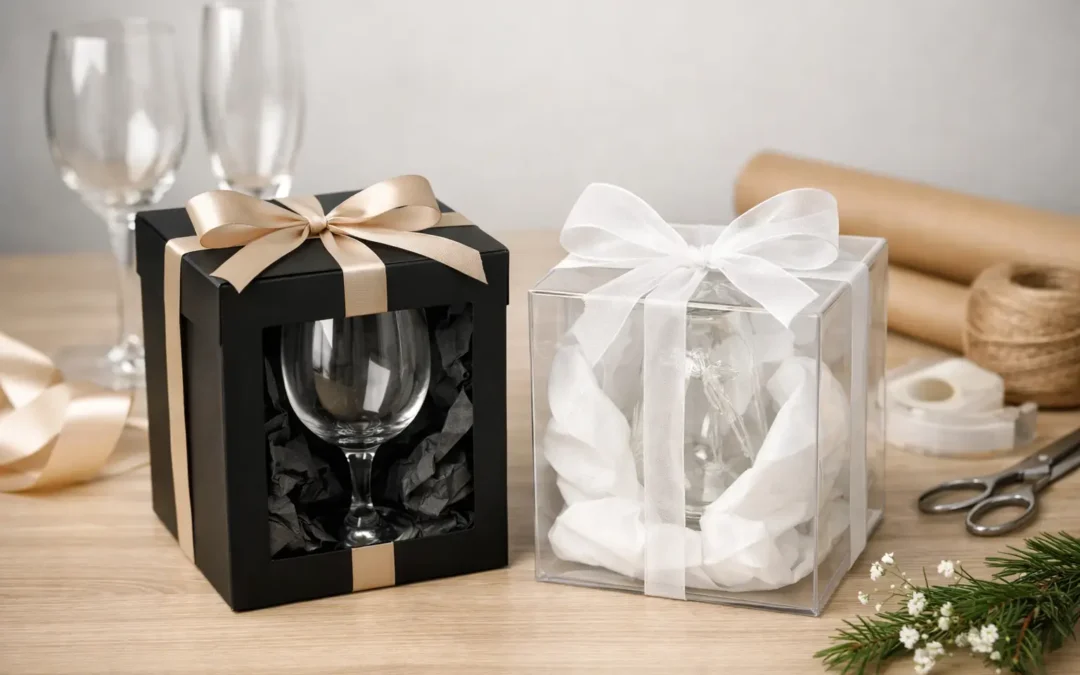
Black cardboard boxes work well when you want a more premium, understated finish. They suit corporate gifting, retail presentation and curated sets with wine or spirits. Clear PVC or PET boxes are a strong option when you want the glassware to remain visible, especially for wedding favours, event gifting or retail display where presentation sells the product before the box is opened.
There is a trade-off here. Clear boxes show off the product immediately, but they also show every detail of the inner wrap, so your presentation needs to be tidy. Cardboard boxes are more forgiving and often provide a stronger branded feel, but they hide the item until opening. The right choice depends on whether visibility or a more premium reveal matters more for the occasion.
Matching the box to the glassware type
Wine glasses and beer glasses usually benefit from upright packaging that supports their height. Tumblers and shot glasses are easier to pack in compact box formats, which can be useful for gift packs or multi-item sets. Decanters and carafes often need more internal space and stronger support, especially if they are paired with matching glasses.
If you are preparing gifts at volume, consistency matters just as much as appearance. Using the same box style across a run of event gifts or promotional packs saves packing time and creates a cleaner result across the full order.
How to wrap glass for gift sets and paired items
Single-item wrapping is fairly straightforward. Gift sets take a bit more planning because the challenge is not just protecting each piece, but making sure the whole set looks intentional.
If you are pairing glasses with a bottle, keep hard surfaces from touching each other directly. A wine bottle shifting against a glass inside the same package is asking for trouble. Each item should have its own space or divider, with enough separation to prevent impact during transport. This is particularly important for winery gifts, settlement gifts, client hampers and promotional packs.
For a pair of glasses, symmetry helps. Wrap both pieces in the same way so the presentation feels balanced when opened. If one sits higher than the other, or one has visibly more bulk around it, the set can look rushed. This sounds minor, but in branded gifting and event presentation, small details affect perceived value.
You also need to think about unpacking. A gift should feel easy to open, not like a packing exercise. That is where fitted gift boxes often outperform improvised wrapping. They reduce the need for excess filler and create a cleaner presentation from the start.
When simple wrapping is enough and when it is not
Not every glass gift needs a complex packaging setup. If the item is being handed over in person and not travelling far, a tidy wrap and a quality gift box may be all you need. For wedding place settings, thank-you gifts and local event handovers, this approach is often practical and cost-effective.
If the gift is being transported, stored in bulk or packed as part of a larger campaign, simple wrapping may not be enough. Bulk handling changes the risk. Boxes get stacked, moved, bumped and loaded in vans. What looks secure on a desk can become loose very quickly in transit.
That is where purpose-made packaging earns its keep. It saves time, reduces breakage risk and gives you a presentation standard that is easier to repeat. For businesses, that is not just about protection. It is about avoiding replacement costs, delays and awkward gifting outcomes.
Common mistakes that make glass gifts look cheap
Most presentation issues come back to poor fit. Too much tissue, oversized boxes and loose filler can make even premium glassware feel like an afterthought. On the other hand, under-wrapping creates a different problem – the gift may look clean at first glance, but it lacks the security needed for real handling.
Another common mistake is choosing decorative materials that shed, crease badly or hold moisture. Glass shows fingerprints, dust and marks very easily, especially in clear packaging. Clean materials and a neat finish always look more professional than busy wrapping with too many add-ons.
Colour choice matters as well. Black packaging has a strong premium look and suits branded or formal gifting. Clear packaging feels lighter and more display-focused. Neither is better in every case. It depends on the audience, the event and whether the goal is a luxury feel or strong visual product display.
A practical approach for events, retail and corporate gifting
If you are wrapping glassware for a one-off personal gift, you can afford to spend extra time on hand finishing. If you are preparing 50, 200 or 500 units for an event or campaign, speed and repeatability become part of the decision.
That is why many businesses move away from improvised wrapping and toward ready-made glassware boxes. They simplify packing, give a more consistent result and make ordering easier when you know the glass type and quantity in advance. For larger runs, custom-made packaging can also help if you want a better fit, a more specific presentation outcome or a branded look without making the packing process harder.
For Australian event planners, wineries, gift businesses and promotional buyers, the smartest option is usually the one that does three jobs at once – protects the glass, presents it properly and keeps packing efficient. That is also where specialist suppliers such as WineBox can make the process more straightforward, especially when you are working with different glass styles or trying to match packaging to a particular occasion.
The best glass gift wrapping does not look overdone. It looks secure, considered and ready to hand over with confidence. If the packaging fits the item and the occasion, the glassware does the talking the moment it is seen.